
Built as an expendable, short-duration turbojet engine for single-mission applications, it can power tactical cruise missiles, anti-ship missiles, and long-range loitering munitions.

The Indian Air Force demonstrated its operational versatility by landing various military aircraft on an emergency airstrip on the Purvanchal Expressway in Uttar Pradesh.

The United States Central Command (CENTCOM) has launched self-defence strikes against multiple targets in Iran, citing ongoing Iranian aggression. This action has led to Iran's Red Crescent placing emergency centres on high alert amidst reports of explosions in several Iranian cities. Concurrently, Iraqi media claims Iran retaliated with a missile strike on a US air base in Erbil.

A lesson for India is to clearly define objectives beforehand, so that the adversary or other parties do not attempt to mitigate them midway.

The Kuwaiti Army reported intercepting hostile missile and drone attacks, while tensions escalate between the US and Iran with reported strikes and confrontations near the Strait of Hormuz.

Hours after US President Donald Trump on Wednesday said that the ceasefire deal with Iran was "over", the US President indicated that Washington could launch another round of strikes against the Islamic Republic, following strikes on Tuesday, saying it had already hit Tehran "very hard" and warning of further attacks.

Iran's Islamic Revolutionary Guard Corps (IRGC) on Sunday claimed it had destroyed eight US military infrastructures in Kuwait and Bahrain in a joint missile and drone operation, describing the strikes as retaliation for a second wave of US military attacks on Iranian targets.

The United States military and Kuwaiti air defence forces successfully intercepted multiple Iranian ballistic missile and drone attacks targeting Kuwait and Bahrain, with Iran's state broadcaster claiming American military installations in Kuwait were deliberately targeted.

The Indian military will showcase an Operation Sindoor-themed tableau for the Republic Day parade, highlighting the jointness of the three services and India's military capabilities.

The United States conducted retaliatory strikes against Iran, targeting over 80 sites, after accusing Tehran of attacking commercial vessels in the Strait of Hormuz, while Iran condemned the US decision to revoke a temporary suspension of sanctions on Iranian oil sales.

US President Donald Trump has abruptly withdrawn from a peace deal with Iran, citing fresh intelligence of Iranian assaults on commercial vessels in the Strait of Hormuz. The decision, made just a fortnight after celebrating the deal, has led to a significant military escalation in the region, with the US launching extensive counter-operations against Iranian military infrastructure.
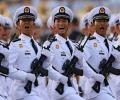
The Chinese military is planning to revamp its English-language instruction in its academies to improve graduates' communication skills on the international stage, according to an article by senior lecturers from the People's Liberation Army (PLA).

In her address to the nation on the eve of the country's 80th Independence Day, the president stressed that just as government and society remain united to ensure national security, everyone must contribute through joint and concerted efforts to safeguard the present and future of students.

From Lakshya to Shershaah, revisit 10 Hindi films and shows that captured the courage, sacrifice and emotional cost of the 1999 Kargil War.

The next-generation missile is expected to be substantially smaller and lighter than the current BrahMos, which weighs around 3 tonnes. The reduction in weight could allow fighter aircraft to carry more missiles per sortie, enhancing combat effectiveness.

A new report from the Stockholm International Peace Research Institute (SIPRI) indicates that India has expanded its nuclear arsenal and is developing long-range weapons capable of reaching targets across China, while also maintaining focus on its rivalry with Pakistan.
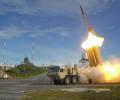
The US has reportedly depleted nearly half of its advanced missile-defence interceptors while defending Israel during recent hostilities with Iran, raising concerns about future readiness.

'DRDO has been directed to license missile technologies to the private sector.'

The strike came amid the peace deal talks between two countries and a fragile ceasefire.

Iran's Islamic Revolutionary Guard Corps (IRGC) has claimed to have targeted and destroyed hangars of F-35 fighter jets and struck 21 American air and naval bases across West Asia and the Gulf region, including the US Army's command and control centre at the Al-Azraq base in Jordan and the US Fifth Fleet headquarters in Bahrain.

On the first anniversary of Operation Sindoor, the Indian military issued a stern warning to Pakistan, stating that no terror sanctuary across the border is safe and that India will continue to dismantle terrorist infrastructure.

Prime Minister Narendra Modi and Indonesian President Prabowo Subianto have significantly advanced the India-Indonesia Comprehensive Strategic Partnership, securing crucial agreements on defence, critical minerals, and maritime security, including BrahMos missile supply and Sabang port development.

The Indian Army held its Army Day Parade outside a cantonment area for the first time in Jaipur, showcasing military might and capabilities.
Following the signing of a 14-point Memorandum of Understanding (MoU) with Iran, US President Donald Trump reiterated the terms for a 60-day negotiation period, vowing that Tehran will receive "not ten cents" in financial relief.

The Indian Air Force (IAF) is establishing a maintenance facility for GE Aerospace's F404-IN20 jet engines, which power the Tejas light combat aircraft, with technical support from GE Aerospace. This initiative aims to enhance India's indigenous defence capabilities and reduce reliance on overseas repair centres.

Amid ongoing ceasefire negotiations, Israel is on high alert, fearing a potential surprise missile and drone attack from Iran targeting Gulf countries and Israel, according to intelligence officials.

The sesquicentenary of 'Vande Mataram' was the overriding theme of the ceremonial event held at the Vijay Chowk and presided over by President Droupadi Murmu, who arrived at the venue in a traditional buggy to the sound of bugles, adding a ceremonial grace to the occasion.

India is increasingly focusing on long-range weapons capable of reaching targets across China.
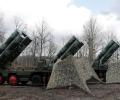
The Indian Defence Ministry has approved the procurement of weapons and military hardware worth Rs 2.38 crore, including S-400 missiles and medium transport aircraft, to bolster the Indian Air Force's capabilities.

The Beijing summit may have reduced immediate diplomatic uncertainty, but it did not resolve the deeper structural contest between the United States and China. That contest appears likely to define the coming decade, notes Varun Arya.
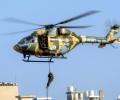
'The tools of warfare are changing. The MoD must deepen its engagement with technology thinkers that can present compelling visions of where warfare may be heading.'

The Israeli Air Force has destroyed an aircraft used by Iranian leadership at Mehrabad International Airport in Tehran, along with striking over 200 targets across western and central Iran, significantly impacting Iran's strategic capabilities.
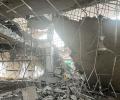
Indian Air Force S-400 Sudarshan Chakra air defence missile systems were fired last night against targets moving towards India. The targets were successfully neutralised in the operation multiple domain experts told ANI.

The report describes the Pahalgam terror attack orchestrated by Pakistan as 'deadly insurgent attack that killed 26 civilians in India's contested Jammu and Kashmir region.'

Lieutenant General Seth's involvement in the army's capability development and modernisation efforts is evident from the key appointments he has held in the Strategic Planning and Capability Development Directorates, including Colonel Capability Development for Mechanised Forces, Brigadier Perspective Plans and Acquisition, and Additional Director General Capability Development.
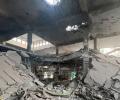
Under Mission Sudarshan Chakra, the country's national security shield is to be expanded by 2035 to ensure comprehensive protection of both strategic and civilian critical infrastructure.

TARA is India's first indigenous modular glide weapon, capable of transforming conventional unguided warheads into long-range precision-guided weapons.

China has denied any links to the Iranian cargo ship seized by the US in the Gulf, which allegedly contained chemical materials for manufacturing missiles. The denial follows allegations by former US envoy to the UN Nikki Haley, who claimed the ship was headed from China to Iran.
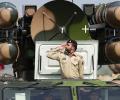
Pakistan has increased its defence budget by 17.6 per cent to PKRs 3,000 billion for the upcoming fiscal year, as announced by Finance Minister Muhammad Aurangzeb. The federal budget, estimated at PKRs 18,771 billion, targets 4 per cent GDP growth, with significant allocations for debt service and pensions. Prime Minister Shehbaz Sharif highlighted economic stability and ongoing discussions with the IMF, while the opposition protested Imran Khan's incarceration during the budget session.

Russian President Vladimir Putin asserted that any attempts to undermine India's sovereignty through 'threats of sanctions' would 'boomerang immediately' under Prime Minister Narendra Modi's leadership, highlighting India's sovereign decision-making and strong national interests.
